Kelly Lin

The Last Mission
Overview
The Last Mission is a 2D grid turn-based stealth game. You will play the role of a hired killer named Harold, who needs to complete the last mission before his contract expires. He needs to sneak into a mansion to collect all the missing files and kill the target. However, as the mission progresses, he will find that everything is not what it seems to be.
Genre: Strategy, Puzzle
Engine: Unity (C#)
My Roles & Contribution
Stealth & Puzzle Mechanics in a Grid-Based System
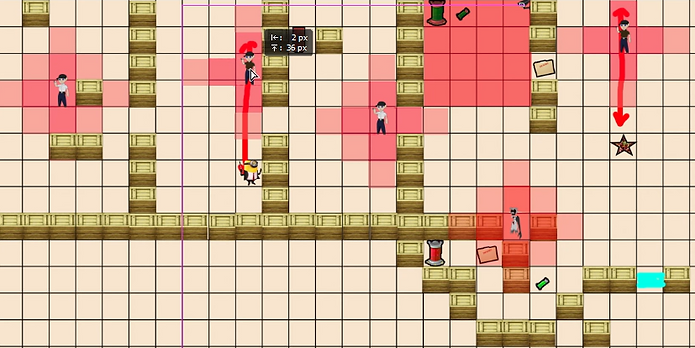
The core mechanic loop—each step forward in the turn-based grid is a puzzle in itself. The stealth system relies on clear but strict vision logic: enemies scan cross-shaped patterns and react based on what they detect. Players must experiment with props, manipulate sightlines, and plan multiple turns in advance. Traps, alarms, and hiding spots are all part of a carefully layered interaction matrix.

Grid-Based System
Enemy AI Patterns and Vision Design
A scalable AI pattern system was built where each enemy behaves differently, rather than simply increasing difficulty by adding more enemies. Each enemy has a distinct movement rhythm, chase protocol, and vision range, allowing players to intuit and adapt their strategies. For example, players can lure guards with sound, use traps to isolate patrols.

Enemy AI Patterns and Vision Design
Narrative-Driven Level Progression and Pacing
Level difficulty, enemy complexity, and emotional narrative tension are in parallel, making each stage feel like a step deeper into the unknown. Stage 1 begins with clean, rational layouts in corporate buildings, introducing mechanics and pacing players through methodical turns. In Stage 2, environments distort, and Pigman enters—faster, weirder, breaking previous rules. Stage 3 places players in Harold’s twisted home, where the boss sees the entire map and forces desperate counterplay.

Storyboard & Narrative-Driven Level Progression Sample
Player Action Design and Trap-Based Counterplay
Beyond moving, players can interact with their environment—turning off cameras, jumping boxes, or laying traps to set ambushes. Player actions were designed around cost (AP per move) and visibility, requiring players to weigh stealth against speed. For instance, jumping over a box costs 2AP, meaning enemies may catch up unless the trap is well placed.

Mechanic Design Document
Puzzle Difficulty Calibration through Paper Prototypes
To balance puzzle progression across different skill levels, multiple rounds of paper prototype testing were conducted. Players were grouped by experience level and asked to rate puzzle difficulty on a 0–10 scale. Each act was calibrated with a steadily rising average difficulty—Stage 1 around 3, Stage 2 around 5, and Stage 3 around 7—to prevent early drop-off for new players while maintaining meaningful challenge through the finale. These data-driven adjustments allowed emotional beats to align with moments of cognitive tension and relief.
Paper Prototype

Player Observation Note Sample
Branching Narrative and Multi-Ending Integration
Unlike most puzzle games, this one doesn’t end at the last level—it splits. Narrative progression was designed through file collectibles that reveal different parts of Harold’s past, letting players choose what version of the truth they believe and choose an ending. The final stage adapts accordingly: some players run, some confront.
